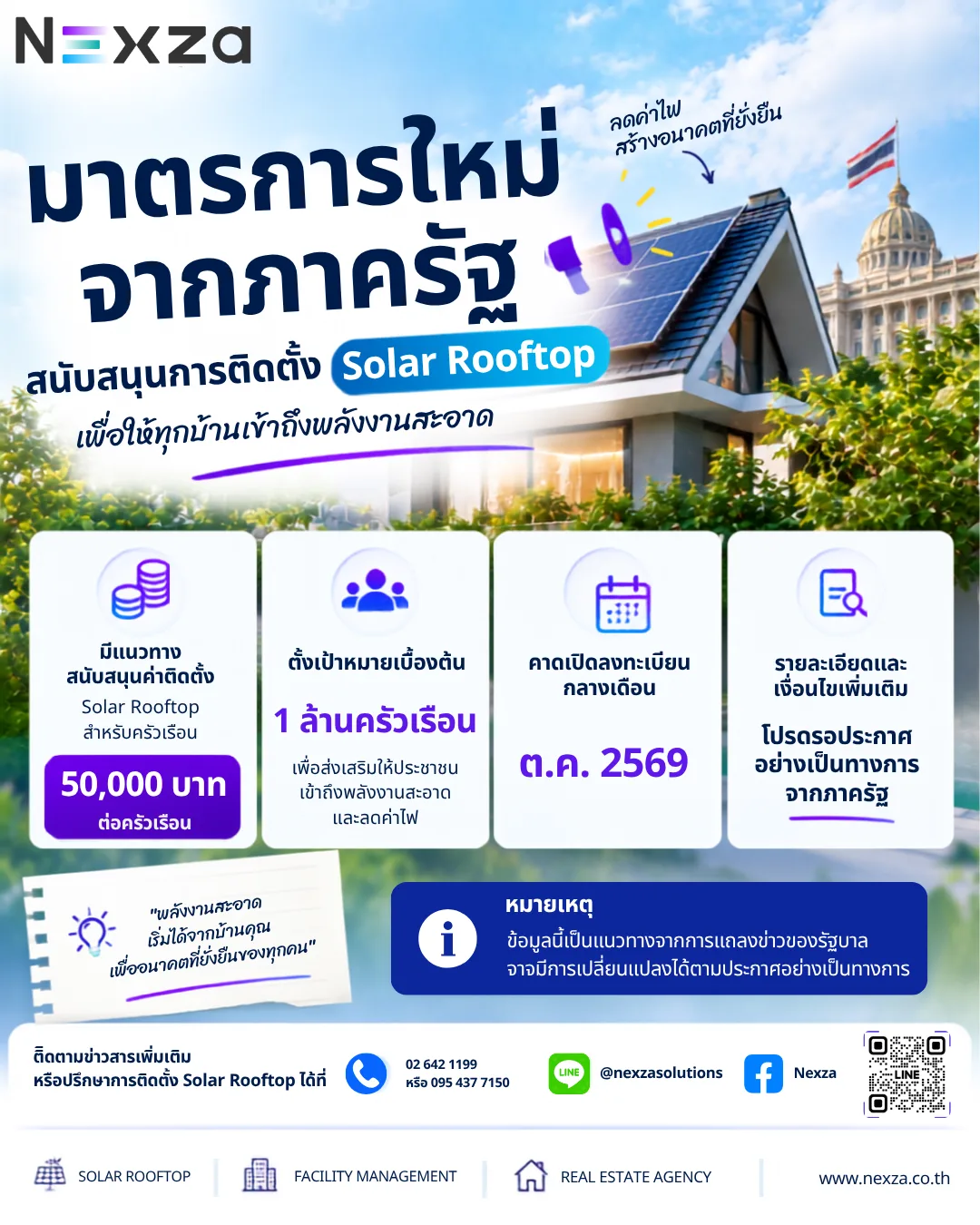
New Government Solar Rooftop Initiative: Up to THB 50,000 in Support per Household
The Thai government is moving forward with efforts to promote residential Solar Rooftop installations to help reduce household electricity expenses, encourage the use of clean energy, and provide more opportunities for the public to participate in solar power generation.
According to the latest information announced on 9 September 2026, the government is preparing to promote Solar Rooftop installations for at least 1 million households, with proposed installation support of approximately THB 50,000 per household. Registration is expected to begin around mid-October 2026.
However, the official details, eligibility criteria, application requirements, and other conditions have yet to be formally announced.
What Is Interesting About the New Solar Rooftop Initiative?
The initiative aims to make Solar Rooftop installations more accessible to households, particularly those seeking to reduce long-term electricity expenses but facing limitations in terms of upfront investment.
Preliminary information indicates several key measures, including approximately THB 50,000 in installation support per household, an initial target of around 1 million households, and cooperation with state-owned financial institutions to provide financing options for households interested in installing Solar Rooftop systems.
The government is currently finalizing the details of the initiative, and the implementation framework may be adjusted before official registration begins.
How Can Solar Rooftop Help Reduce Electricity Bills?
A Solar Rooftop system generates electricity from solar energy through panels installed on the roof of a house. The electricity generated is primarily used within the home, reducing the amount of electricity that needs to be purchased from the power grid.
Households with higher daytime electricity consumption — for example, homes that use air conditioning during the day, have residents working from home, or operate electrical appliances continuously — may be able to utilize more of the solar energy generated and achieve greater savings on electricity costs.
In addition to self-consumption, Thailand’s Solar Rooftop Program for Residential Consumers currently allows eligible households to sell surplus electricity back to the grid. The purchase rate is THB 2.20 per unit, with an electricity sales capacity of up to 5 kW per meter and a 10-year power purchase period.
Note: The existing surplus electricity purchase program is already in operation and is separate from the proposed government installation support of approximately THB 50,000 per household, which is currently awaiting further official details.
What Should You Consider Before Installing Solar Rooftop?
The cost-effectiveness of a Solar Rooftop system should not be determined solely by system size or installation price.
Several factors should be considered, including average monthly electricity bills, daytime electricity consumption patterns, available roof area and orientation, the household electrical system, and whether the main objective is to reduce electricity expenses or sell surplus electricity back to the grid.
Choosing a system that matches actual electricity usage can help maximize the use of solar-generated power and provide a more accurate estimate of the expected payback period.
Let Nexza Help Assess the Right Solar Rooftop System for Your Home
If you are considering installing a Solar Rooftop system, Nexza can provide an initial assessment based on your electricity bill, available roof area, and electricity consumption patterns.
Our team can help recommend an appropriate system size based on the actual energy requirements of your household.
For more information:
Phone: 02 642 1199 or 095 437 7150
LINE OA: @nexzasolutions
Facebook: Nexza
Website: www.nexza.co.th
Disclaimer: The information regarding the government support initiative in this article is based on information released as of 9–10 September 2026. The support amount, eligibility requirements, registration schedule, and other conditions may be subject to change. Please refer to official announcements from relevant government agencies before making any decisions.